Industrial exoskeletons are wearable frames that help a worker hold, lift, or move through a repeated task. Their value depends less on the robot-shaped frame than on fit, comfort, and the exact motion the job requires.
- Passive models use springs or other mechanical parts, so they don't need a battery.
- Powered models use motors and sensors to add force during a task.
- The main test is the full work period, not a short demonstration.
What an industrial exoskeleton does
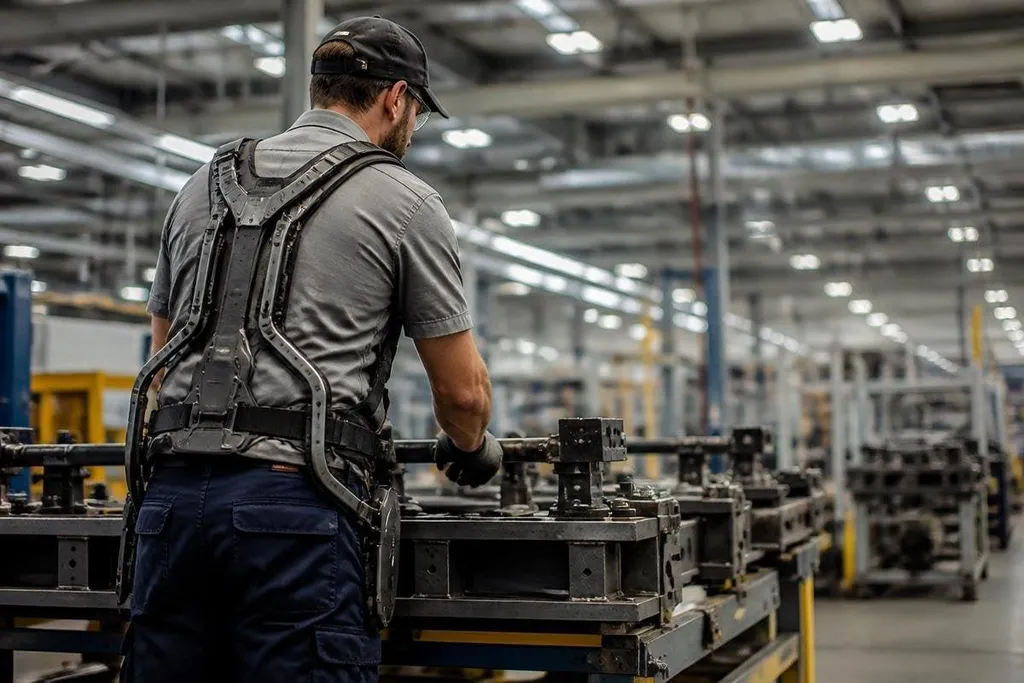
An exoskeleton sits on the body and moves with the worker. Some designs support the back during lifting. Others hold the arms during overhead work or help spread a load across the hips and legs.
Passive systems store and return energy through springs, hinges, or other mechanical parts. They can be lighter and easier to maintain because they don't need motors, software, or a battery. Their tradeoff is range: the support works best during the movements the frame was built to assist.
Powered systems add motors, sensors, and a control system. Sensors detect movement, then the controller sends force to an actuator, which is the part that creates motion. That added hardware can help with a demanding task, but it also brings charging, service, weight, and safety work.
The distinction matters on a production line. Workers who change tasks often may find a fixed support pattern awkward. Someone who repeats one overhead motion for hours may gain more from a frame built for that exact movement.
Where the machines can help
Factories and warehouses use people for tasks that are hard to automate fully. A worker may need to pick different parts, inspect a surface, carry a tool, or reach into a changing space.
An exoskeleton can stay with the worker while the task changes around them. The best fit is a job with a clear physical demand. Repeated overhead work, long periods with the arms raised, and manual handling can give designers a measurable target.
The frame can shift some load away from a joint or hold part of the arm’s weight, but it doesn't remove the need for good work design.
That last point matters because an exoskeleton can change where force goes. If a frame eases the back, it may add pressure at the hips, legs, or shoulders. A worker may also change posture to fit the device. Any trial needs checks from the people doing the job, not only data from the frame.
An exoskeleton trial needs more than a lower-back force reading. The record should name the job, frame, time worn, and changes in output or discomfort. Robot24 gives you reports on wearable robots to compare with those results before the hard limits come into view.
The hard limits
Comfort is a work requirement. A frame that rubs, traps heat, limits walking, or makes a tool harder to use will spend more time beside the workstation than on the worker.
Fit creates another limit. Body size, clothing, footwear, and task height all affect how the frame transfers force. A device that fits one worker may need adjustment for another, and the adjustment must be quick enough for a real shift.
Powered systems add a second set of questions. The battery needs to last through the planned work period, and the controls need to respond when the worker stops, turns, or changes direction. A motor that adds force at the wrong moment can create a new hazard.
The business case also needs more than a lower strain score. A site must count training time, cleaning, charging, repairs, storage, and changes to the work area. It should also check whether workers can keep their normal pace while wearing the frame.
A practical buying check
Use this list before a pilot begins:
- Name the exact motion the device should assist.
- Measure the task without the frame, including time, load, reach, and breaks.
- Ask workers to wear it through a complete work period, not a short trial.
- Check walking, tool use, emergency movement, and access to controls.
- Record pressure, heat, rubbing, and new load on other body parts.
- Price batteries, cleaning, training, repairs, and replacement parts.
The result should be a task decision, not a robot count. If the frame helps one repeated motion and stays comfortable through the work period, it may earn a place there. If the job changes every few minutes, a redesigned workstation may be the better buy.
I’d buy an industrial exoskeleton only after the worker trial shows a clear task benefit without adding a new burden. The next useful number is not the launch price; it’s the share of a full shift during which people choose to keep wearing it.